
Join us for this online seminar exploring Lacanian conceptions of trauma and their place in clinical practice, with Dr Leslie Chapman.
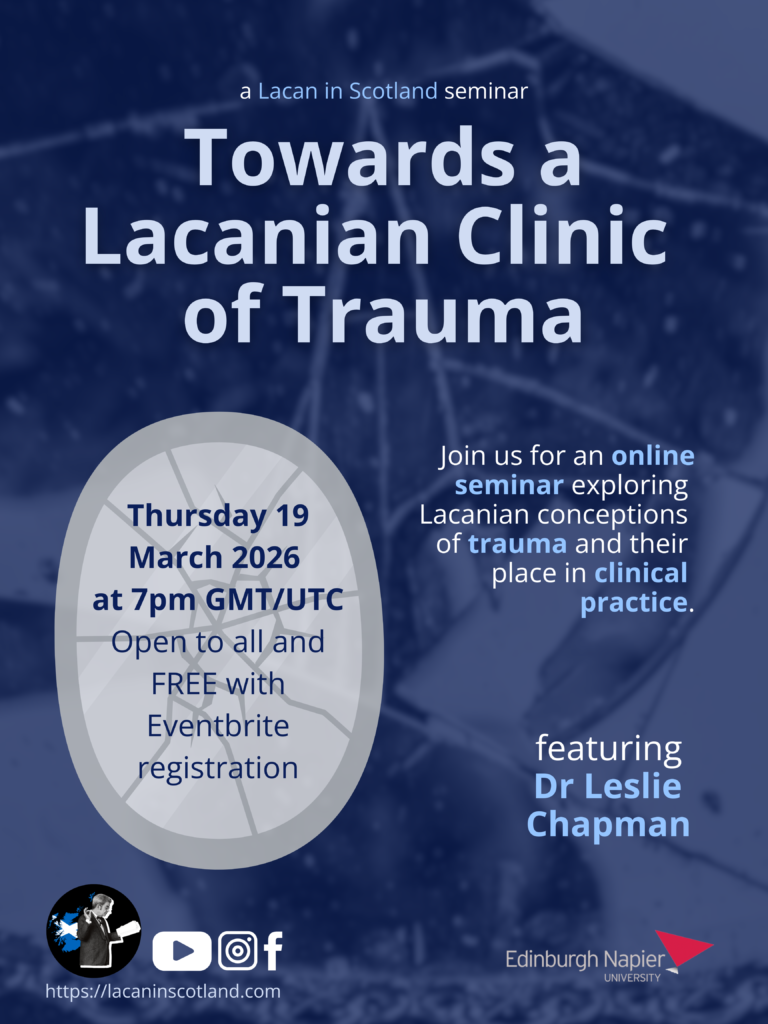
Towards a Lacanian Clinic of Trauma
One of the basic premises of this presentation is that there is a problem within the Lacanian clinic when it comes to working with ‘life traumas’ or, as I prefer to call them, ‘wounds of life.’ There still appears to be a widely held view within Lacanian circles that the term ‘trauma’ refers to the human being’s entry into language and that such a ‘trauma’ not only constitutes or ‘inaugurates’ the human subject but is essentially a ‘one-off’ event. Consequently, when Lacanian analysts are confronted with prospective analysands who have experienced a range of traumatic experiences, for example sexual violence, war, natural disaster, etc, they struggle to situate such experiences within their existing clinical framework. The temptation is then to argue that such experiences lie outside of the remit of psychoanalysis altogether. However, by using Freud’s theory of the traumatic neuroses (the precursor to today’s PTSD), my argument is that this theory provides a ‘conceptual bridge’ between the Lacanian theory of a ‘one-off’, foundational trauma and the many ‘life traumas’ that occur in day-to-day living and which I refer to as the ‘PTSD paradigm’.
My position, which I discuss in detail in my book Traumatic Neurosis Revisited (Palgrave Lacan Series, 2025), is that rather than being a ‘one-off’ inaugural event, the subject is being continually traumatised by the jouissance of the drive (what I refer to as drive-jouissance) and that, furthermore, such drive-jouissance emanates from the symbolic universe that subjects finds themselves immersed in. I use the term drive scraping to describe how the drive is perpetually ‘scraping’ this symbolic universe for surplus jouissance. And in the era of a globalised, hyperreal mediascape, there is never any let-up from such a ‘scraping’ of surplus jouissance. Using Freud’s arguments in Beyond the Pleasure Principle, and Lacan’s reworking of such arguments in Seminar 2, a key part of my thesis is that whilst most of the time most people are able to ‘manage’ the effects of drive-jouissance, there are occasions when the homeostatic functioning of the pleasure principle breaks down and the subject is overwhelmed with the excess excitation of the drive, i.e., they become ‘traumatised’.
With regards to the clinical implications of such a theory (which I do not explore in my book) my contention is that because ‘life traumas/wounds of life’ represent an irruption of the Real into the subject’s Symbolic-Imaginary (their ‘reality’) the aim of analysis is essentially to provide an analytic space for them to construct a new sinthome that will allow them to find a way to engage with the Real of their trauma. Traumatic neurosis does not constitute a new clinical structure, but, rather, is a way of describing the operation of the Real (and its relation to the drive and jouissance) within the life of the subject.
Speaker Biography
Dr Leslie Chapman is a psychoanalyst working within the Lacanian tradition based in North East Hampshire, UK. His analytic formation began at the Centre for Freudian Analysis and Research (CFAR) where he was an Associate Member between 2005 and 2018. In 2023 he completed his doctoral thesis at Kingston University on the traumatic neuroses and their relation to Lacanian and Freudian theory. A book version of his thesis has been published by Palgrave as part of their Lacan Series.
Both his clinical and theoretical interests are focused on the work of the so-called ‘last Lacan’ and its relation to trauma and the Real. He is particularly interested in how psychoanalysis can challenge the dominant ‘PTSD paradigm’ that sees trauma as something purely ‘external’ to the individual and which ignores its subjective dimension. More recently, and especially in the light of the conflicts in Ukraine and the Middle East, he has become increasingly focused on the relationship between war and trauma, including the traumatic legacy of past conflicts. He is also very interested in the way psychoanalytic ideas can be used ‘beyond the clinic’, for example, in the fields of politics, ideology and culture. And, finally, he has a growing interest in the opportunities and threats posed by the incursion of artificial intelligence (AI) into the field of psychoanalysis and the broader talking therapies field.
The seminar will take place on Zoom on Thursday 19 March 2026 at 7pm-8:30pm Greenwich Mean Time (GMT)/UTC*.
The event is open to everyone and free with registration via Eventbrite. The Zoom link will be available for registrants on the ‘Online Event Page’ (found when accessing your ticket on Eventbrite) on the day of the seminar.
*Please note that this event is taking place one week earlier than our usual last-Thursday format. Additionally, as some parts of the world will have moved to daylight saving time while the UK has not yet, the advertised start time may fall at a different time of day for you depending on where you are in the world.
Will Leslie’s presentation be available for viewing? I was disappointed that I could not attend the live event.
Thank you!
Dear Andrew,
Sorry to hear you could not attend, but not to worry as we did record the event and are planning to upload it as soon as possible. Please keep an eye out on our YouTube channel/social media channels or sign up to our mailing list to be notified of our upcoming recordings.
Best wishes,
Amanda